Service
Social & Search Ads
Advertising you can actually do the maths on.
Meta and Google Ads deliver reach in days rather than months, provided the tracking, audience, and landing page are right. I set up the campaigns, measure them properly, and tell you honestly what the channel delivered, even when the answer is inconvenient.
- Campaign setup (Meta & Google)
- Audiences and creatives
- Conversion tracking & pixel with consent handling
- Reporting with honest numbers
When advertising pays off
Ads on Meta or Google deliver reach in days rather than months. That's their only real advantage over SEO, and it's a significant one when you have a date, a season, or a product launch.
They only work when three things are in place: a clear purchase decision, a landing page offering exactly that one action, and clean tracking. Miss one and you burn budget without even knowing why afterwards.
An example from practice
For Echo Fields Festival, a Meta campaign ran on a modest budget in the six days before the event. It reached roughly ten percent of Freiburg's population at €0.17 per click, and a third of the visitors who landed on the page started a purchase.
The reporting afterwards distinguishes between measured and estimated figures. At Echo Fields that also meant naming the clearest weakness openly: six days of run time was too short, and the bottleneck was never the budget.
Ads or SEO?
The question is often framed as either/or, but it's really a question of timing. Both channels deliver visitors, with opposite characteristics.
If you have a date in four weeks, you can't avoid ads. If you want to be less dependent on ad budget in two years, you can't avoid SEO. Most businesses need both, just at different times and in different proportions.
| Paid ads | SEO | |
|---|---|---|
| First results | Same day | After six to twelve weeks |
| Cost per click | Charged on every click | None, once established |
| When the budget stops | Visitors stop immediately | The effect persists |
| Controllability | Audience and timing freely chosen | Dependent on search behaviour |
| Measurability | Click to purchase traceable | Coarser, attribution harder |
| Fits when | Dates, seasons, launches | Ongoing, recurring demand |
At Echo Fields Festival the choice was clear: a fixed date, six days of runway. For the Hofladen portal it was just as clearly the other way round, because the demand exists all year.
What I handle
Campaign setup on Meta and Google, audiences and creatives, conversion tracking with consent handling, and the landing page the clicks arrive on. Plus reporting that distinguishes between measured and estimated figures.
If I think ads aren't worth it in your case, I'll say so. Usually the money is then better spent on the website or on SEO.
ROAS calculator
Advertising doesn't pay off in general, it pays off above certain numbers. Enter what you know about your business and you'll see immediately whether the channel adds up.
Result
- Clicks per month
- ·
- Enquiries per month
- ·
- Orders per month
- ·
- Revenue per month
- ·
- ROAS
- ·
How this is calculated
Budget divided by cost per click gives clicks. The enquiry rate gives enquiries, the close rate gives orders. Orders times order value gives revenue, divided by budget gives ROAS.
A model calculation, not a forecast. It shows the order of magnitude your assumptions produce.
Full calculatorReference projects
All Projects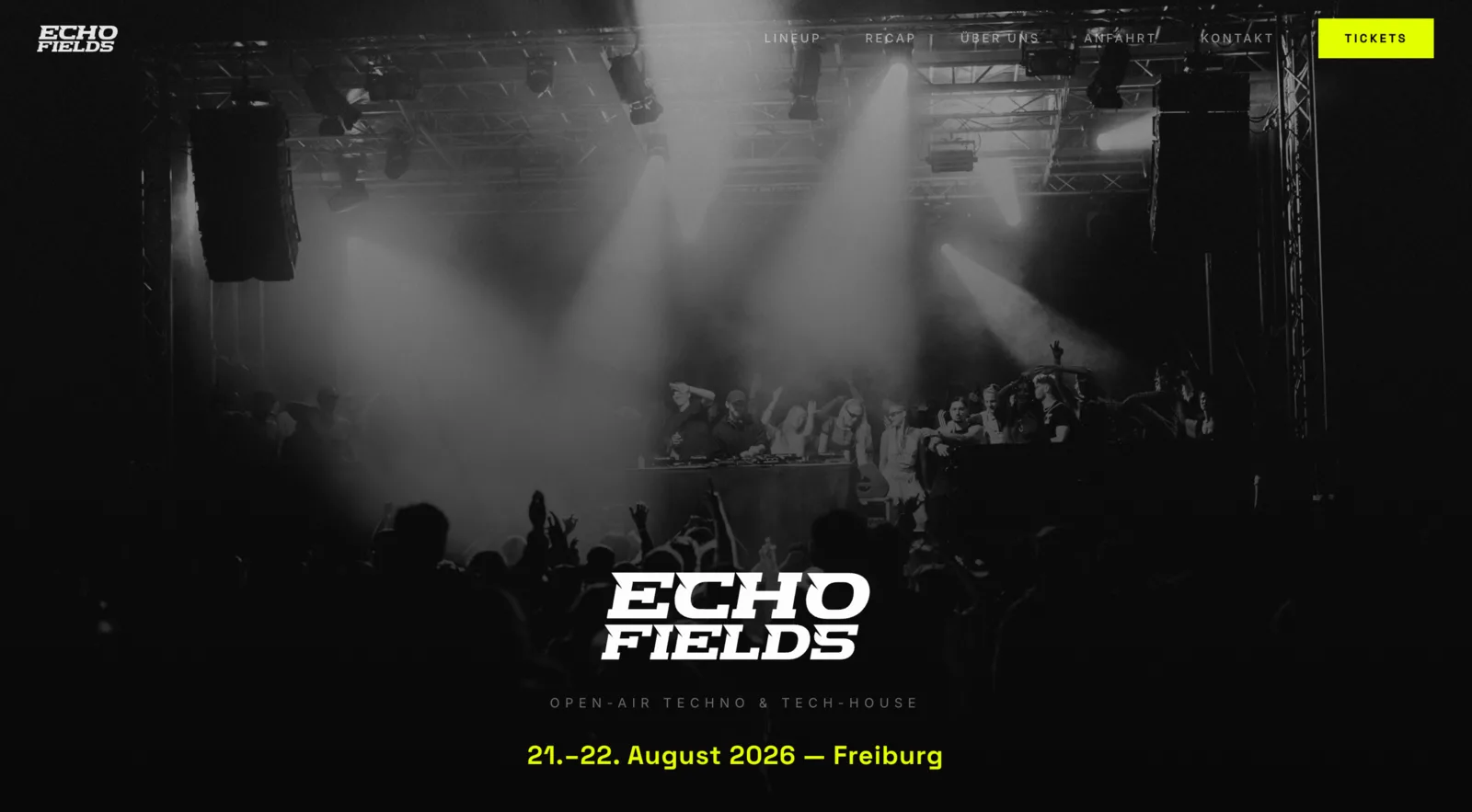
Echo Fields Festival
Website and shop design plus Meta ads for an open-air festival near Freiburg. Two editions supported, from the design to the final-stretch campaign.
GLOBE Efficiency Check
Trade-fair landing page with QR entry and a question-by-question funnel. A prize draw that produces a qualified lead instead of a business card in a fishbowl.
Frequently asked questions about this service
- What's the minimum budget?
- Below roughly €300 a month there's little to learn, because the data volume is too small to evaluate audiences and creatives. It usually becomes worthwhile from €500 to €1,000 monthly, depending on your order value. The calculator below shows the point at which it adds up for you.
- Meta or Google, which is better?
- It depends on whether your customers are already searching. Google Ads reach people with concrete intent, but the click costs more. Meta reaches people who aren't searching right now, more cheaply and with more reach. For dates, events, and offers that need explaining, Meta often works better; for urgent needs, Google.
- Do I need a dedicated landing page for ads?
- In most cases, yes. The homepage offers too many routes and doesn't answer the question someone clicked for. A landing page with exactly one action raises the conversion rate considerably, because it answers the question someone clicked for and offers no second option.
- How is this measured in line with GDPR?
- Tracking runs through consent management: no pixel loads without consent. That costs measurement accuracy, because some visitors decline, but it's the clean approach. I implement this to the best of my knowledge, but I don't provide legal advice.
- How long until ads work?
- First clicks arrive the same day. A reliable read on audiences and creatives takes two to four weeks, because the platforms have a learning phase. At Echo Fields Festival, the six-day run time was the only real criticism.
Other services
Have a similar project in mind?
Tell me about it. I'll reply within 24 hours with an honest assessment.