Service
Website
Fast, clean, built to convert.
A website isn't a digital brochure. It's your busiest showroom. I build sites that load in under a second, look as good on a phone as on a desktop, and guide every visitor to one place: the enquiry.
- Concept, structure, and copy
- Custom design instead of a page builder
- Contact and enquiry forms
- Hosting, domain, maintenance on request
What a website has to do
Most company websites are digital brochures: they describe what the firm does and hope somebody gets in touch. But whoever opens your site decides within seconds whether to stay, and often makes the real buying decision without ever speaking to you.
A website that works answers three questions immediately: am I in the right place, can these people do it, and how do I get in touch. Everything else is decoration. That sounds obvious, but in practice it regularly fails on homepages that open with a mission statement instead of the visitor's problem.
Why load time isn't a technical detail
Google analysed eleven million mobile landing pages across 213 countries and measured the relationship between load time and bounce probability. When load time rises from one second to ten, the probability of a bounce rises by 123 percent.
Those visitors aren't dissatisfied with your offer. They never saw it. They left while the screen was still white.
That's why load time is the one metric I fix before the design rather than optimising afterwards. A statically served page is rarely slow, because it has nothing to assemble when someone requests it.
- +123%
- higher bounce probability when load time rises from one second to ten
- 11M
- mobile landing pages analysed
- 213
- countries in the sample
Shown is the relative increase in bounce probability compared with a one-second load time, not the bounce rate itself.
Source: Google, analysis of 11 million mobile landing pages across 213 countries, 2018
How I work
It starts with structure, not design. Which questions do your customers ask before they buy? In what order? Where do conversations fail today? That produces the site architecture, and only then the look.
It's built statically with Astro. Pages sit finished on the server instead of being assembled on every request. Sub-second load times become the norm rather than the goal. That matters because Google treats load time as a ranking factor, and because every second of waiting costs visitors.
You maintain the content yourself, through a content system or structured files depending on the project. What matters is that changing opening hours or prices doesn't require a developer.
What you end up with
A site that works as well on a phone as on a desktop, is technically clean enough to be found, and guides the visitor to one place: the enquiry. Plus hosting, domain, and ongoing support if you want it.
The site is yours, including access and source code. If you hire someone else later, they can work with it.
| Takes less time than expected | Takes longer than expected | |
|---|---|---|
| Design | The draft itself | Agreeing on it when several people decide |
| Copy | Structure and first draft | Subject sign-off and the final ten percent |
| Images | Embedding and optimising | Organising your own photos instead of stock |
| Technology | Building the pages | Getting access to the domain and legacy system |
| Launch | Switching over and measuring | Legal texts, when they're only considered at the end |
The left column sits with me, the right one mostly with you. That's why the quote states what I need from you and when: three to six weeks is realistic when these run in parallel, and becomes three months when they run in sequence.
Website ROI calculator
A website costs once and works every month. What matters isn't the price but how many visitors end up enquiring. A single percentage point changes the maths considerably.
Result
- Enquiries today
- ·
- Enquiries afterwards
- ·
- Additional revenue per month
- ·
- Pays for itself after
- ·
How this is calculated
Visitors times enquiry rate gives enquiries, before and after. The difference times close rate times order value gives the additional monthly revenue. Investment divided by that figure gives the payback period.
A model calculation, not a forecast. It shows the order of magnitude your assumptions produce.
Full calculatorReference projects
All Projects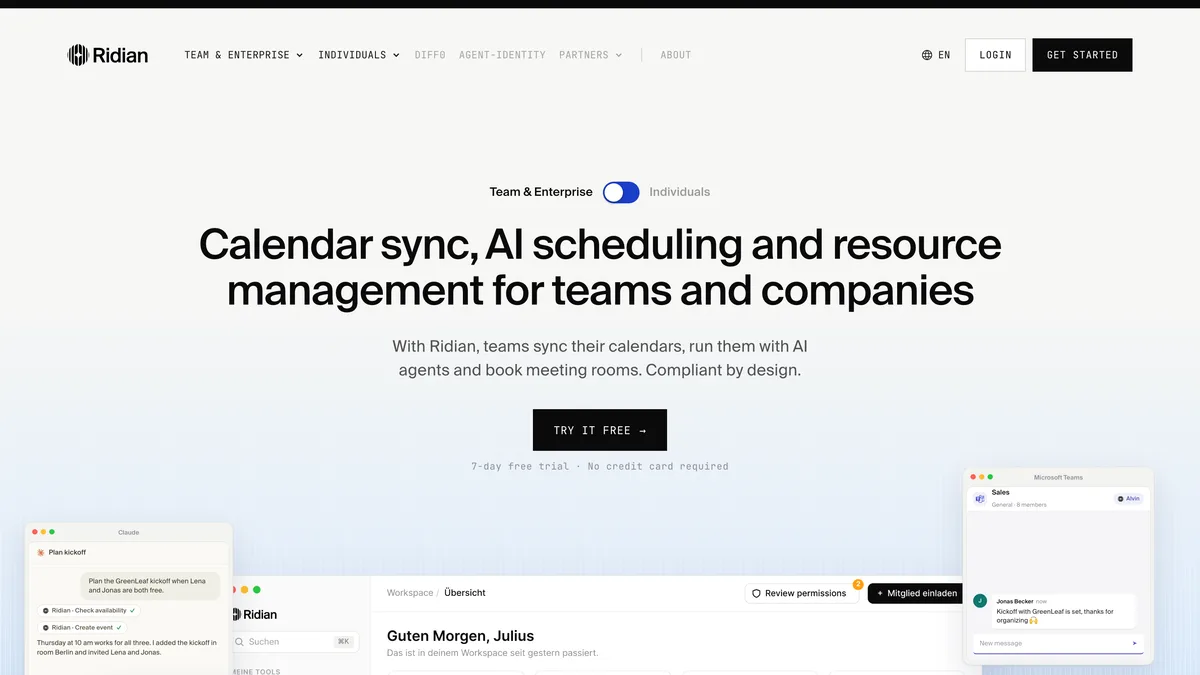
Ridian
Brand identity and website for a scheduling platform for teams and companies. From positioning and logo system through to the multilingual site.

Echo Fields Festival
Website and shop design plus Meta ads for an open-air festival near Freiburg. Two editions supported, from the design to the final-stretch campaign.
Frequently asked questions about this service
- How long does a new website take?
- A clearly scoped company site is usually live in three to six weeks. The biggest time factor is rarely the technology, it's copy, images, and sign-off on your side. That's why the quote states exactly what I need from you and when.
- Can I edit the content myself?
- Yes. Depending on the project you get a content system where you maintain text, images, and pages yourself. At VuV Events that runs on Storyblok, where the client changes products and categories without me. A site only the developer can touch is out of date within a year.
- Do I need WordPress?
- In most cases, no. WordPress brings maintenance overhead, security updates, and load-time problems a statically built site simply doesn't have. If you have a large editorial team or depend on specific plugins, it can still be the right choice.
- What does a website cost?
- A company website typically lands between €3,000 and €6,000, a one-pager between €1,500 and €2,500. I work with fixed prices: after the intro call you get a price and a scope I stick to.
- What happens after launch?
- On request I take over ongoing support: updates, small changes, monitoring, and reporting. If you'd rather handle it yourself, you get a walkthrough and documentation. Either way, access and source code are yours.
Other services
Have a similar project in mind?
Tell me about it. I'll reply within 24 hours with an honest assessment.