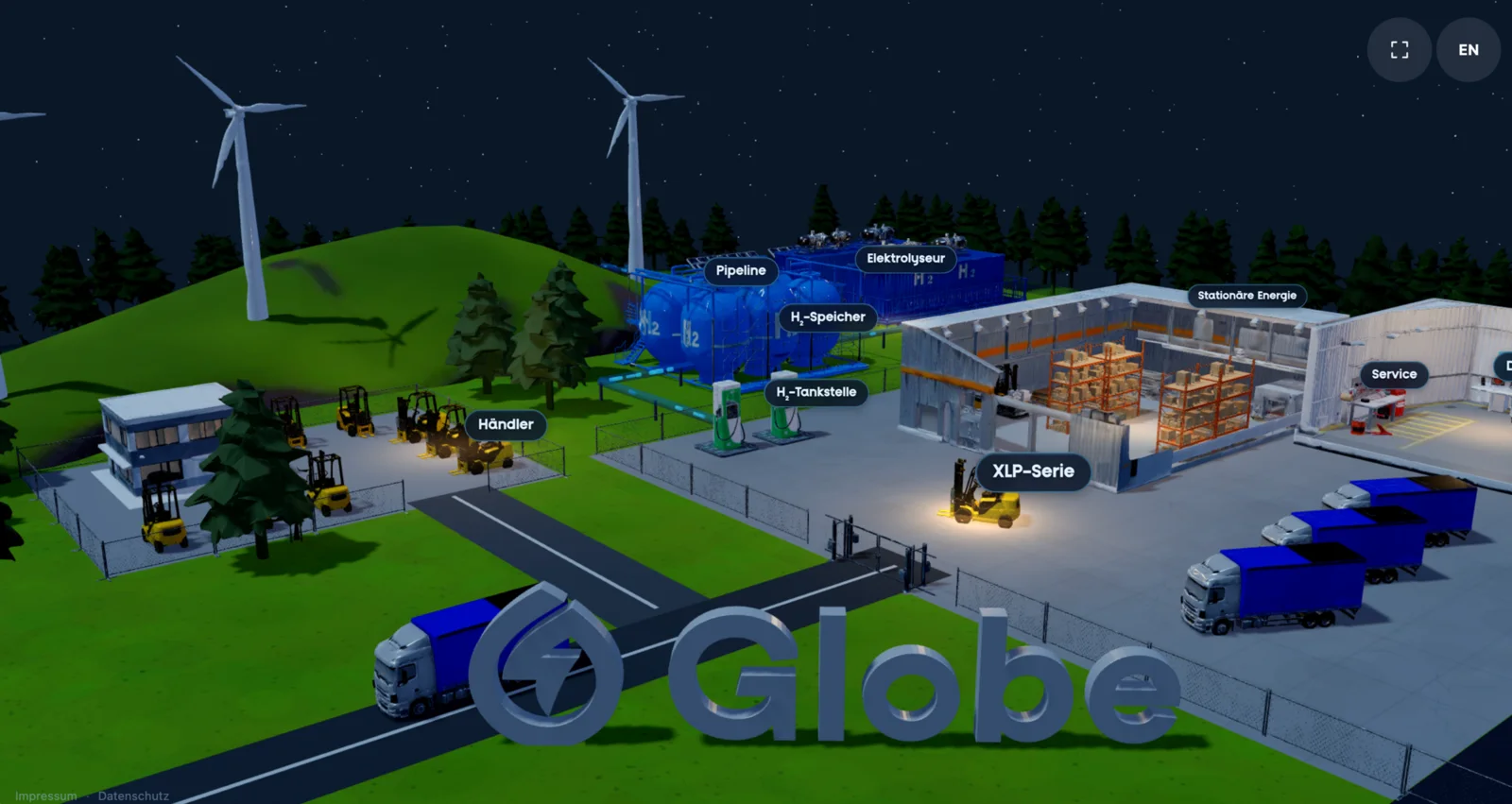
GLOBE H₂ 3D World
Interactive 3D world of the hydrogen value chain for trade-fair kiosk and web. Model data cut by 76 percent, running at 70 to 120 frames per second.
The brief
GLOBE Fuel Cell Systems builds hydrogen technology. The problem with explaining it: the value chain, from generation through transport and storage to application, is abstract, distributed, and nearly impossible to convey in the two minutes you get at a trade fair.
Instead of another slide deck, the goal was a navigable 3D world where visitors move between the stations themselves. It had to serve two environments at once: the touchscreen at the stand, where reliability beats everything, and the ordinary browser, where it runs on unknown hardware.
The hard part
3D in the browser rarely fails on looks, it fails on weight. The original model data was heavy enough that the scene stuttered on weaker hardware and the first load became a test of patience.
The biggest lever was texture memory, which started at 1,085 MB. Alongside it sat a detail nobody could place for a while: every building looked dirty. The cause wasn’t the lighting but a metallicFactor: 1 carried over from the model export, which treated every surface like raw metal.
What the optimisation achieved:
- Model files: 101.6 MB → 24.8 MB (down 76 percent)
- Texture memory: 1,085 MB → 191 MB (down 82 percent)
- 70 to 120 frames per second when measured
That made an additional planned compression step unnecessary, saving both effort and another potential source of bugs.
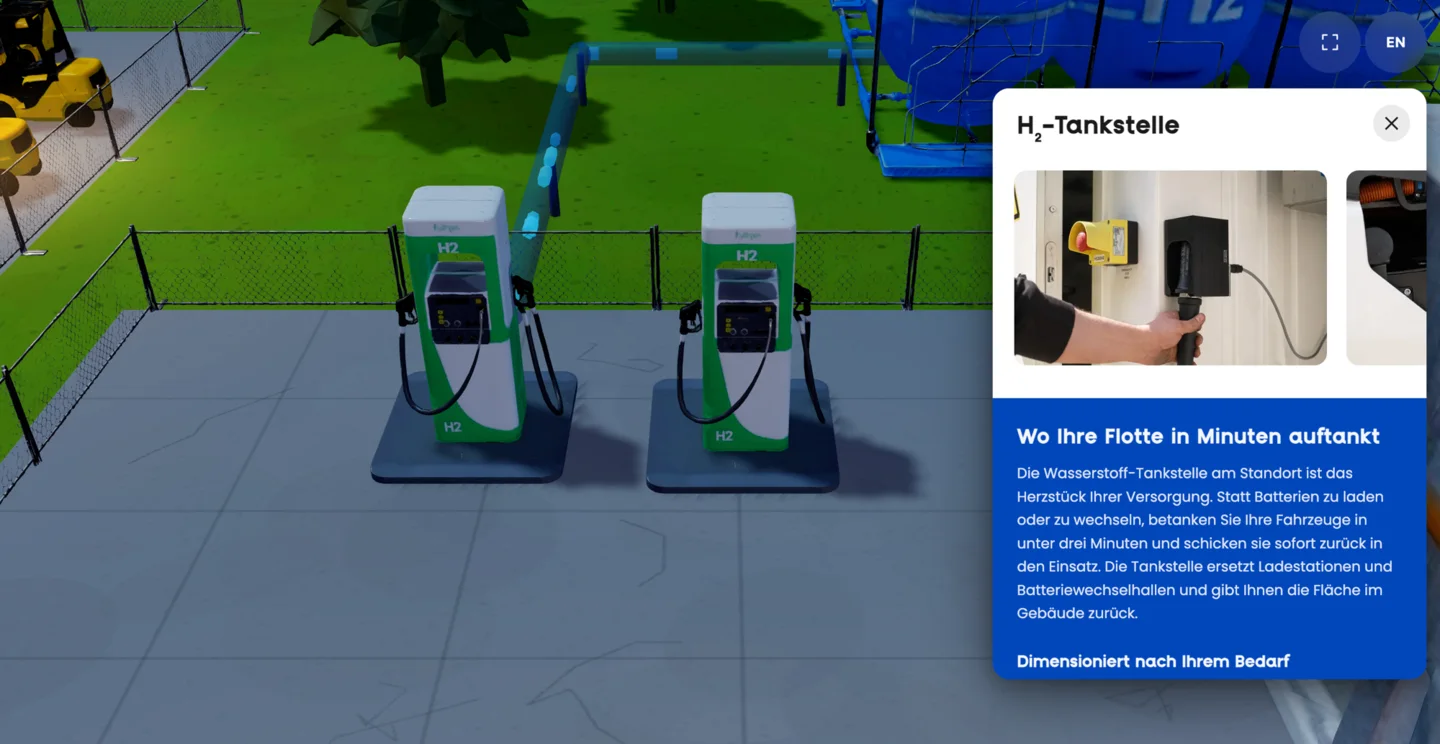
Built for the trade-fair floor
A kiosk has requirements that simply don’t exist on the web:
- Offline operation: a dedicated build runs without internet, because trade-fair Wi-Fi is not something to depend on.
- Watchdog and startup script: the machine boots, the application starts, and if it crashes it comes back on its own. Nobody at the stand should have to open a terminal.
- Auto tour: after two minutes without input the scene tours the stations by itself and becomes an eye-catcher again, instead of sitting on an abandoned intermediate state.
- Constrained controls: zoom and camera paths are bounded, so nobody can navigate out of the world and leave the stand in a broken state.
Content editable without a developer
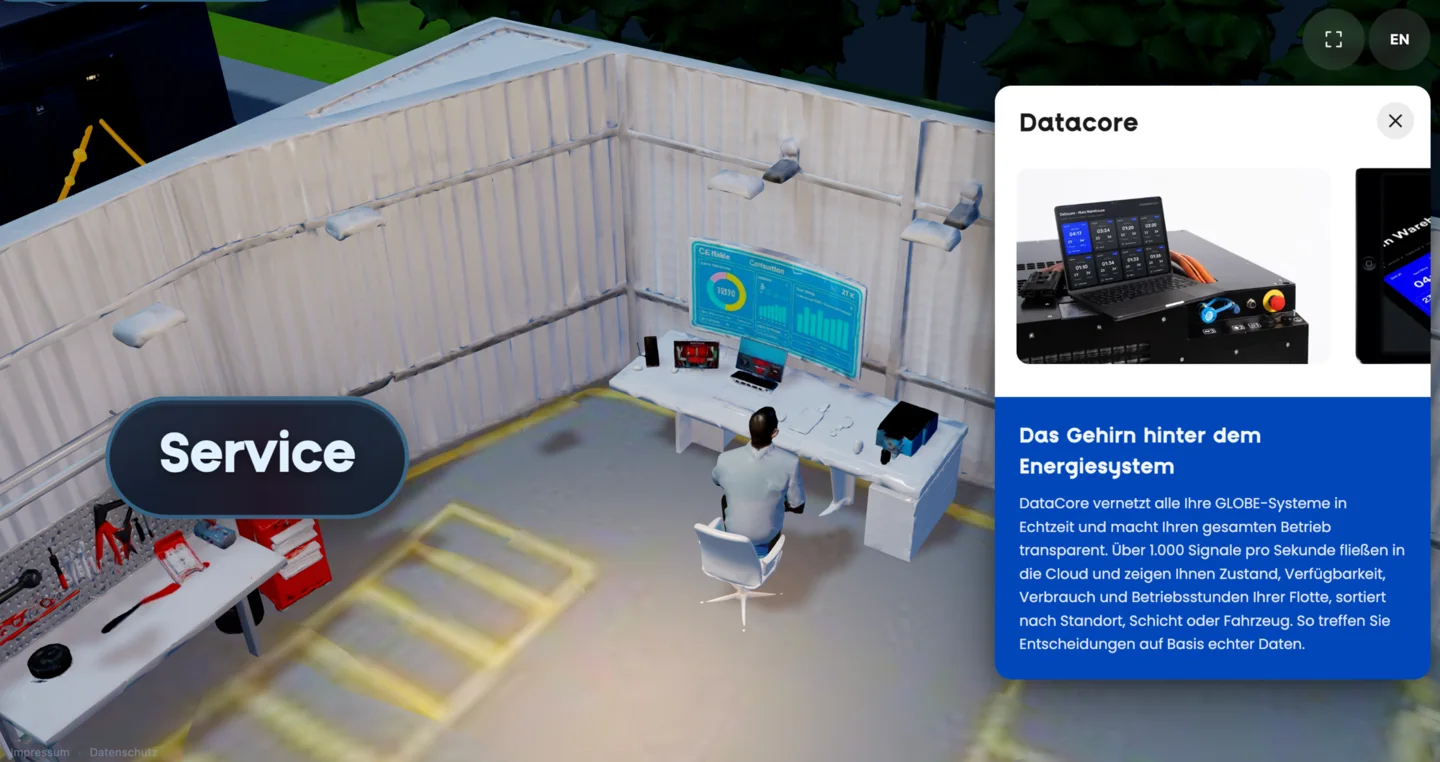
The text for every station lives in a content system, in both languages. GLOBE can change content without anyone touching the 3D application. Where a translation is missing, a fallback takes over instead of an empty card.
Outcome
The 3D world was signed off in August 2026 and runs both on the web and as an offline kiosk. The project was handed over in full: its own repository, hosting in the client’s account, content-system access, and a setup guide for the kiosk hardware.