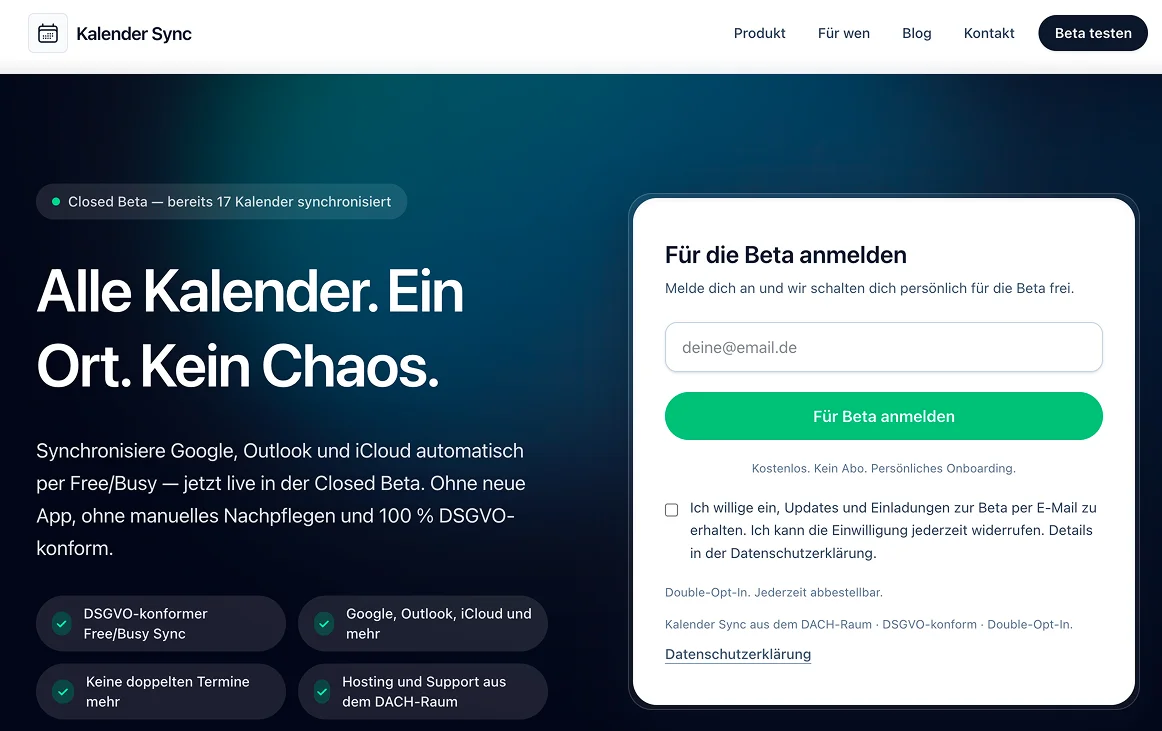
Kalender-Sync
Live SaaS for calendar synchronisation with over 3,000 users. Free/busy instead of event content, five providers, hosted in Germany. The product for individual users that the Ridian platform grew out of.
The product
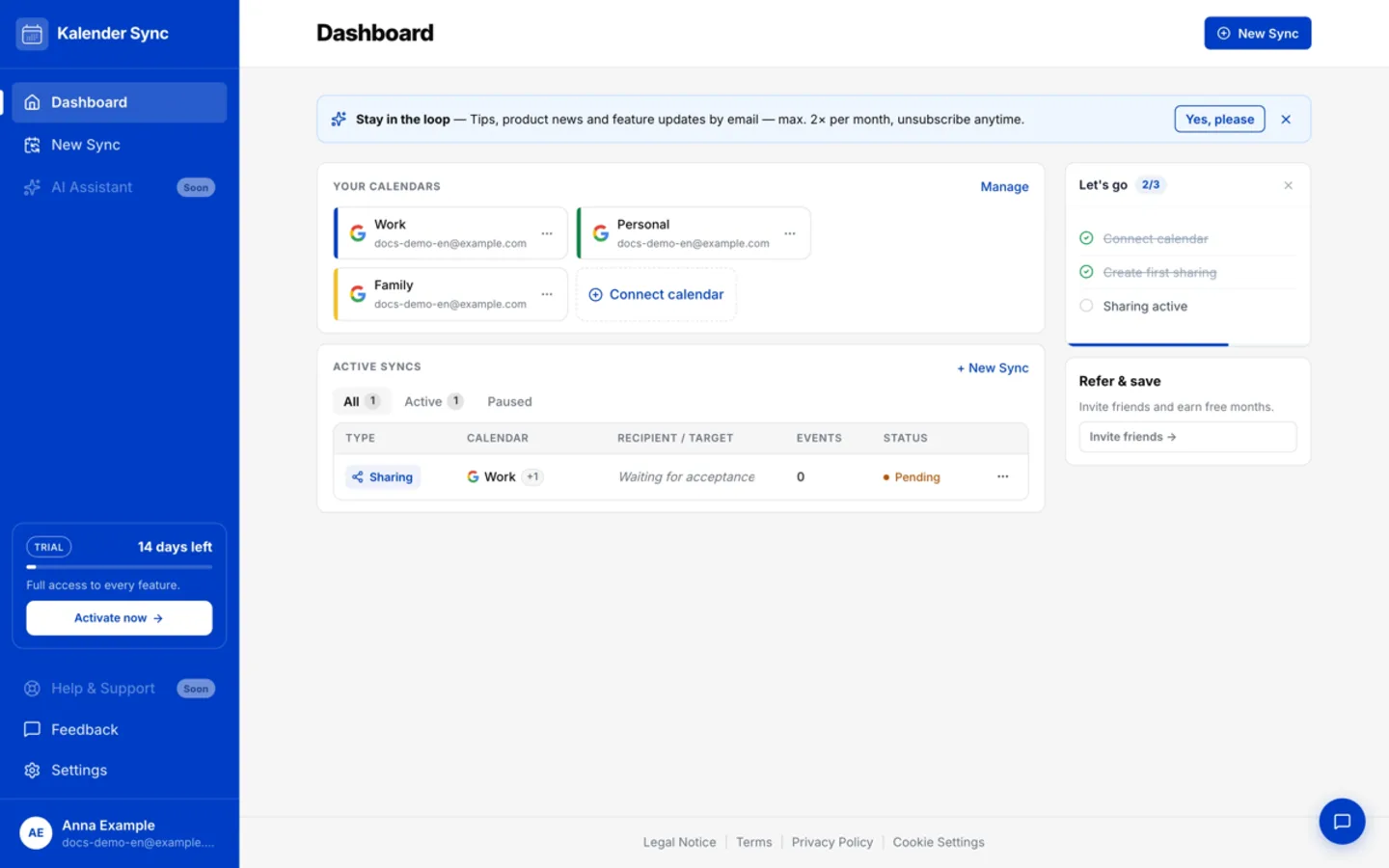
Anyone running separate work and personal calendars knows the problem: appointments are scattered across Google, Outlook, and Apple, and double bookings only surface when it’s already too late. Add a couple of clients and you’re juggling four or five calendars at once.
Kalender-Sync reconciles availability between those providers automatically. The decisive difference from US competitors lies in what is not transferred: only free/busy slots move, never titles, attendees, or notes. Private event details never leave the calendar where they were created. Each connection controls how much becomes visible, from “busy only” through to full detail.
The product has been publicly available on a freemium model since May 2026 and now serves over 3,000 users. The entire stack is hosted in Germany, with a data processing agreement and encryption for all stored credentials.
Under the hood
- Multi-provider architecture: one abstracted interface for Google Calendar, Microsoft Graph, Apple iCloud and KSuite via CalDAV, plus iCal feeds. Adding a provider is an implementation against an existing interface, not a rebuild.
- Real time instead of polling: sync via OAuth webhooks, with CalDAV polling where a provider allows nothing else. Changes land in the target calendar within seconds rather than at the next interval.
- Encryption: ChaCha20-Poly1305 for all stored tokens and credentials, so database access alone yields no usable calendar connections.
- Reliability: a job queue with retry logic, so a brief provider outage delays appointments rather than swallowing them.
- Time zones and recurring events: the two areas where calendar software usually breaks, and correspondingly the part with the most test cases.
- Billing: Free, Basic, and Business through Stripe, with correctly stated VAT and a trial phase.
- Stack: TypeScript, Node.js, PostgreSQL, Drizzle ORM, hosted on own infrastructure in Germany.
Why it belongs here
Kalender-Sync is my own product and at the same time the testing ground for everything I offer clients. Positioning, landing page, SEO, and pricing were all tried here first, before they went into client work.
The practical upside: when I tell a client something will take longer than they hoped, or which edge case gets expensive later, it comes from running a product with my own money rather than from a conference talk.